1- THE PROJECT
El Árbol de los Anhelos – Codex of Human Rights is a long-term visual project originally conceived as a series of thirty large-scale works, each dedicated to one article of the Universal Declaration of Human Rights. It has evolved into an open system without a fixed sequence, where additional works emerge in response to context, opportunities, and the state of the world.
The first phase of the project (four paintings) was supported by Colombia’s Ministry of Culture, Arts, and Knowledge. The work continues to develop through institutional support, grants, residencies, and public presentations.
ARTIST STATEMENT
A central question in my practice is how to face human suffering and what position I occupy as an artist within that condition.
My practice develops through calligraffiti as a structural language that brings together calligraphy, typography, and graffiti as distinct but interdependent systems. Within this framework, writing functions as a system that organizes concepts into space.
El Árbol de los Ánhelos engages the Universal Declaration of Human Rights as a non-binding text that has become significant through repetition, circulation, and belief, grounded in a fragile consensus imagining a better world for all. In this sense, the Declaration functions as a framework for approaching the question of human suffering, not as an answer but as a collective attempt that remains open.
Calligraphy operates as a temporal event in which marks emerge through gesture and accumulate over time, producing forms that resist immediate stabilization into meaning. Typography organizes formal and conceptual structures through specific systems, while graffiti establishes scale, surface, and the conditions of encounter.
Each work is constructed through repetition, layering, density, and scale, allowing different positions to exist within the same surface. These compositions operate as structured fields in which tensions remain active. The project unfolds as a codex in space, where each work maintains its own internal logic while forming part of a larger structure, and relationships across works allow meaning to circulate rather than stabilize.
Through artist talks and live painting, I construct situations of encounter in which participants confront their own contradictions in relation to this question. These are spaces where conflicting positions can coexist without the need for resolution or conclusion. The work establishes conditions in which individuals remain present to what they perceive, allowing tension and contradiction to remain active.
Across the work, calligraffiti operates as a system in which event, structure, and encounter are held together, constructing a field where meaning, organization, and experience remain active.
Project Context
In 1991, while I was a student at the University of the Andes, my country, Colombia, was exhausted by violence, bombings, and fear. Students across the nation organized the Seventh Ballot, a civil movement demanding change. I campaigned for it, marched for it, and witnessed an entire generation come together to imagine a different future. Somehow, we found the strength to write a new constitution, one that, for the first time, gave voice to Indigenous, Afro-Colombian, and marginalized communities. It was a powerful moment. For an instant, as a country, we felt hope.
Shortly thereafter, the poet Jairo Aníbal Niño wrote El Árbol de los Anhelos, a children’s book created to explain the new Constitution. His words captured that moment with precision: the dream of building a society for all.
Years later, I felt that same sense of hope upon discovering the Universal Declaration of Human Rights. Created after the Second World War, it was drafted by representatives of many nations, cultures, and religions. The Universal Declaration of Human Rights was the first global document explicitly written with the intention of addressing all human beings: not a nation, not an empire, not a religion, not a class.
As a non-binding document, it operates through repetition, circulation, and belief, formed through a fragile consensus imagining a better world for all. I understand that it is not a perfect solution, but it remains a powerful symbol.
For more than twenty years, I have kept, in plain sight in my studio, a small notebook containing the Declaration, a silent reminder of that dream. Many times I tried to express it through art, but I did not yet have the right language.
These paintings come from that same place: the one that longs for a better life for all, the one we recognize when we hear the words, “I have a dream.”
Through calligraffiti, I found the language that allows me to work with this text.
The paintings do not follow a fixed sequence. They respond to the moment I am in, to what the future brings, to each opportunity, and to emerging questions. They evolve over time, opening space for conversations we still need to have.
02 - PROJECT STATUS AND LEGEND
Quick guide to the symbols used below.
🟢 Completed
🟡 In progress
CO Exponsored by theMinistry of Cultures, Arts, and Knowledge of Colombia
03 - MAIN ILLUMINATIONS
+ Click to open each illumination +
Each illumination gives visual form to one of the thirty articles of the Universal Declaration of Human Rights.
Preamble 🟢 * CO
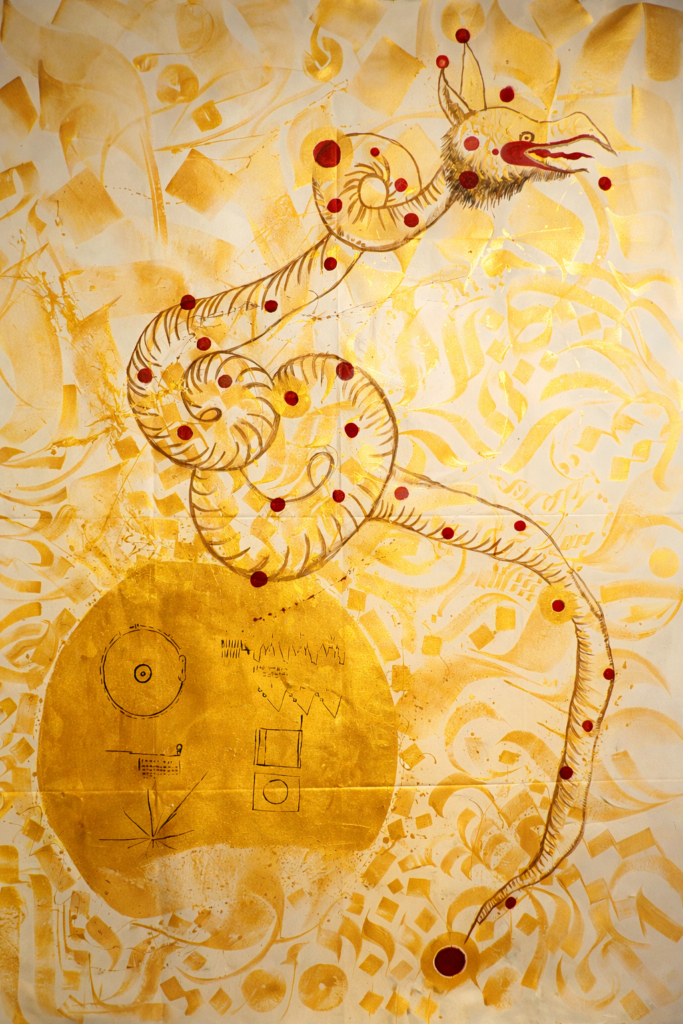
Acrylic on canvas. 9.84 ft × 16.40 ft. / 3 m × 5 m
This work interprets the Preamble of the Universal Declaration of Human Rights as a shared point of departure for humanity.
The golden disc refers to the Golden Record, conceived in 1977 by Carl Sagan and his team and sent into space aboard the Voyager probes. This record contains sounds, music, images, and scientific information selected to represent human life on Earth. In this work, the disc retains its original condition: it continues traveling through the universe as a bearer of a human message.
Inside, it appears graphic symbols and sonic references that allude to a curated synthesis of humanity, in keeping with the spirit of the Preamble, an ethical aspiration toward dignity, coexistence, and the absence of war, disease, and cruelty.
The figure that envelops the disc is the Hydra, taken from the Book of Fixed Stars, a medieval Arabic astronomical manuscript. This reference acknowledges the fundamental role of Arabic knowledge in the historical construction of astronomy. The serpent is not presented as a threatening figure, but rather as a way to represent the universe that surrounds and contains the human message, as well as the unknown we still face as a civilization.
The Preamble, like this disc in transit, does not describe a finished reality, but an ethical horizon under permanent construction.
Read: the Universal Declaration of Human Rights
Watch video: explanation of Carl Sagan’s Golden Record and the Voyager missions
Watch video: complete audio (5 hours)
Watch video: the 116 photographs included on the record
Consultar manuscrito: Consult manuscript: Book of Fixed Stars (digital / e-book version)
Article 1 🟢 *CO
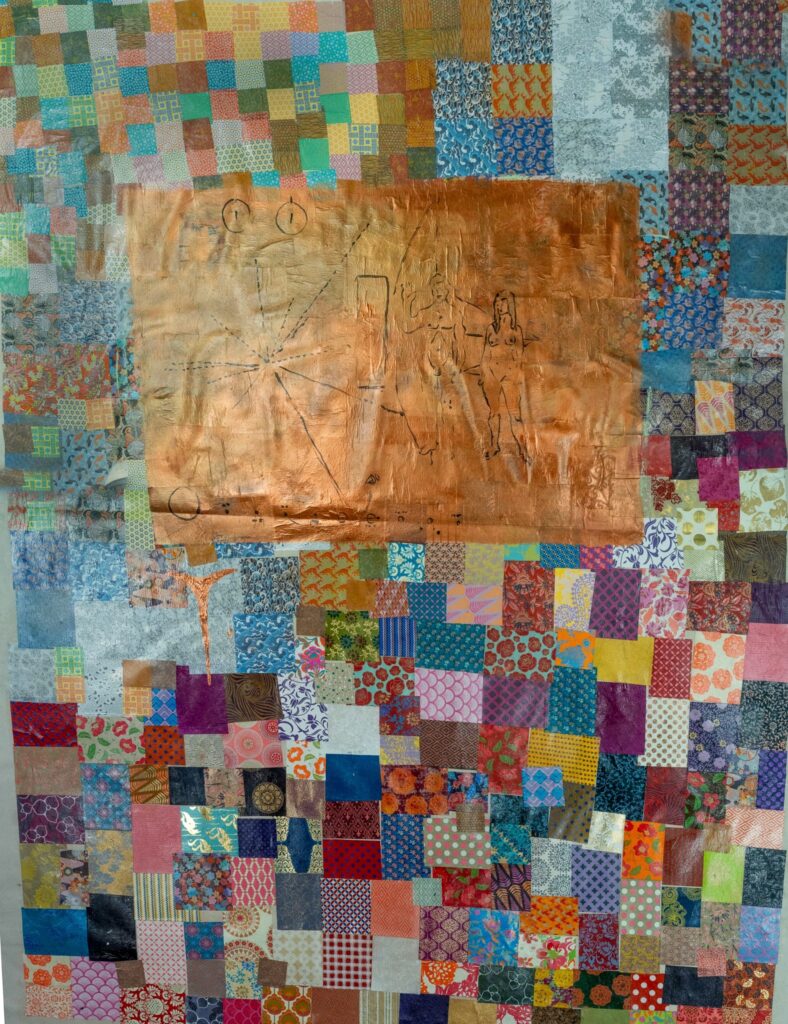
Acrylic on Canvas and Paper pasted on canvas. 3 Mts X 2 Mts / 9.8 ft × 6.6 ft
“All human beings are born free and equal in dignity and rights.”
This work is conceptually grounded in Carl Sagan’s plaque on Pioneer 10 and in the real difficulty of creating an image that can represent all of humanity without excluding races, bodies, or cultures. During its development, certain images of the human body were questioned within NASA, revealing the cultural and political limits involved in attempting to speak on behalf of the entire human species.
Article 1 of the Universal Declaration of Human Rights affirms the inherent equality and dignity of all people, yet that affirmation has proven complex to translate into a single, universal image.
Faced with this impossibility, the work adopts the quilt’s structure as a visual and conceptual strategy. The quilt allows diverse fragments to be brought together without erasing their differences, proposing an idea of equality based on the coexistence of multiple identities within a single fabric.
In the lower left portion of the work appears the Sumerian symbol for the number one, one of the earliest known graphic forms used to represent beginning and unity. This sign explicitly points to Article 1, linking the origins of writing and human thought to the fundamental principle of equality that inaugurates the Declaration.
Watch: the video that tells the history of the plaque.
04 - EMERGING ILLUMINATIONS
+ Click to open each illumination +
Emerging Illuminations are works within the codex that do not correspond to a single article of the Universal Declaration of Human Rights, but instead address foundational or interstitial themes.
As the Codex evolved, certain themes demanded their own space: works that did not belong to a single article but to the human stories that exist between them.
New branches of the same tree.
Genocide – The Silence of Names 🟢 * CO
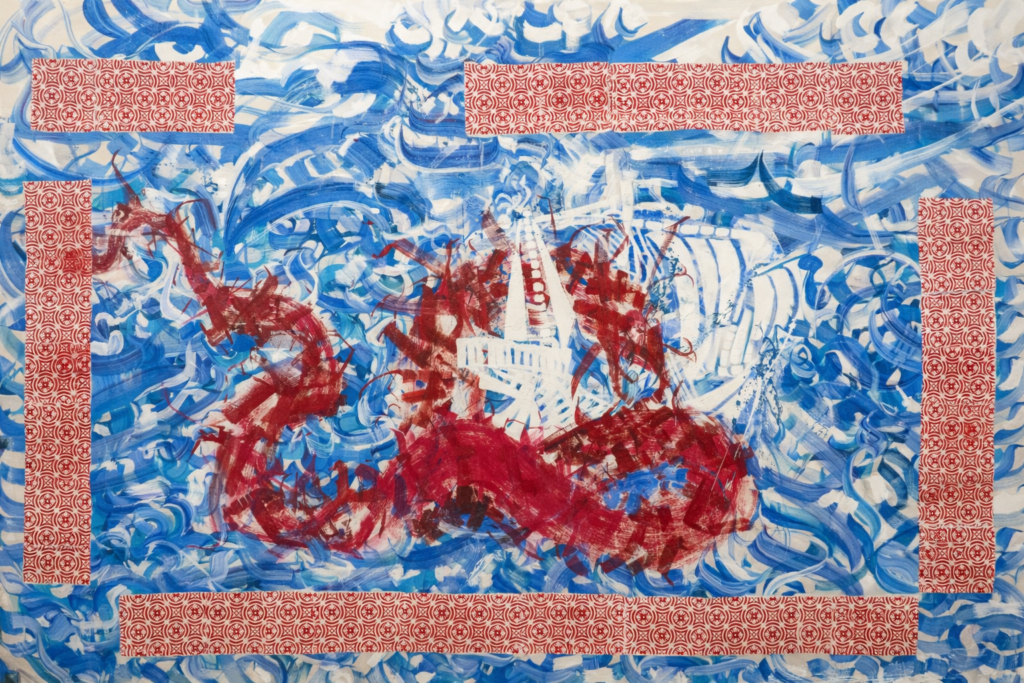
Acrylic on canvas and fabric pasted on canvas 3 m × 5 m ≈ 9.8 ft × 16.4 ft
Genocide does not appear as a specific article within the Universal Declaration of Human Rights. The Declaration was conceived as a preventive framework: its articles seek to establish the conditions necessary to ensure that crimes such as genocide do not occur again. The prohibition and legal codification of genocide were later developed in specific instruments of international law.
However, during the process of creating this series, genocide emerged as an essential concept, not as a norm, but as a latent threat: that which the Declaration attempts to prevent and which, nevertheless, continues to occur. This work is the most personal of the entire series.
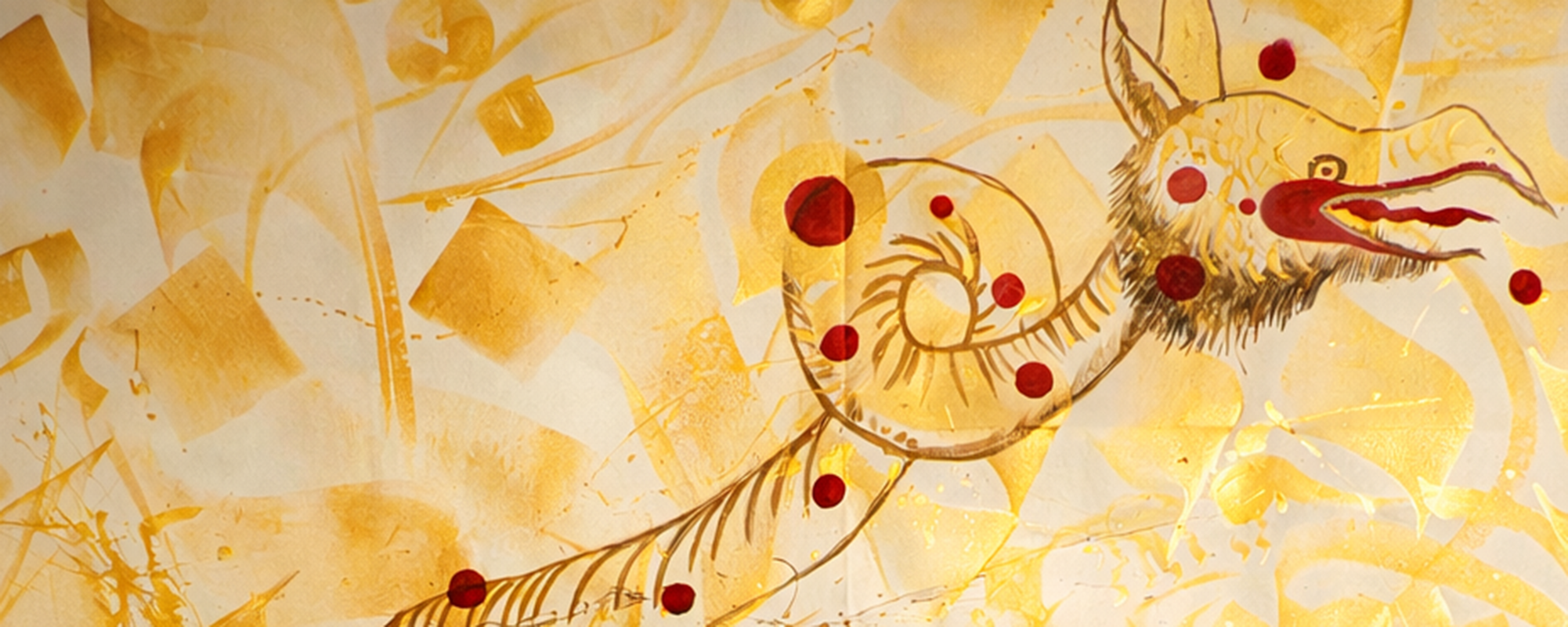
The red geometry surrounding the dragon represents my childhood home, specifically the swimming pool where we bathed as children. It was not a tiled pool but a dark, deep concrete structure, where the bottom could not be clearly seen. In that depth, my imagination populated monsters that could grab my feet and drag me downward. From that fear, the dragon is born.
The dragon resumes its function in medieval cartography, where such figures marked zones of danger, unknown territories, and real or imagined threats. Unlike other symbolic representations in this series, this dragon is destructive. In the image, it appears as a red force devouring a ship, without ambiguity.
As an interpreter in asylum cases, every person I accompany could be a member of my family or my close circle. Genocide ceases to be an abstract category and becomes a concrete human experience, repeated, recognizable.
In this work, genocide is presented as a fear we do not always see, but one that may be waiting at the bottom of the unknown. It is not a memory of the past, but a possibility that persists when human rights fail.
See: the map that inspired me to paint this dragon.
Life: The Fundamental Right🟢 * CO
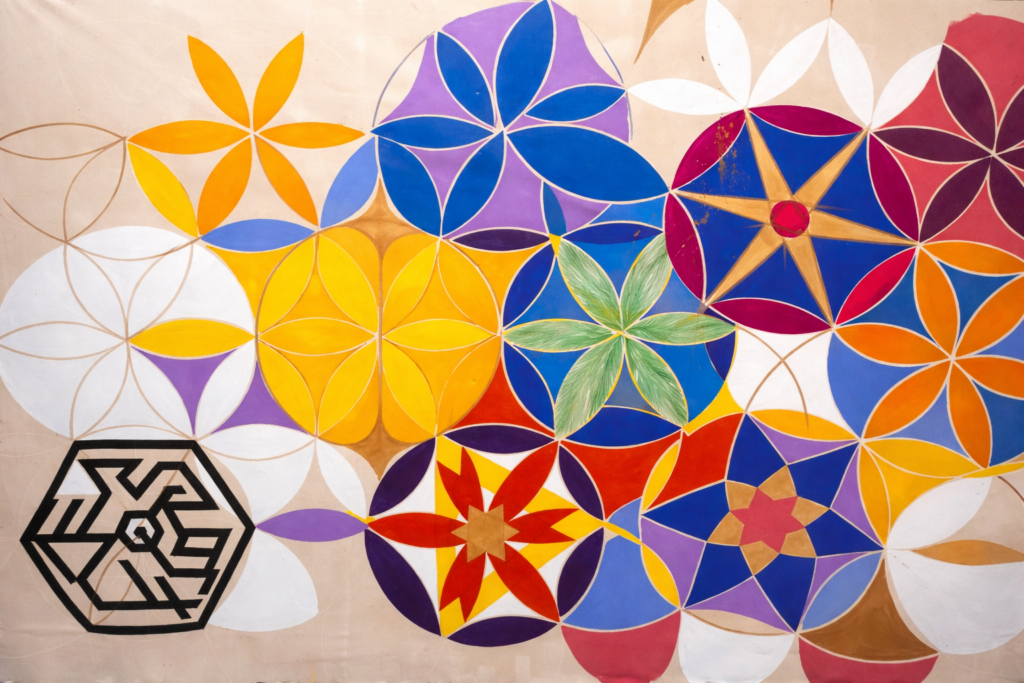
Acrylic on canvas and fabric pasted on canvas 3 m × 5 m ≈ 9.8 ft × 16.4 ft
The entire Universal Declaration of Human Rights is based on a basic premise: in order to have rights, one must be alive. Although the right to life does not appear as an autonomous article, it is implicit in each of its articles.
This work represents life through the Flower of Life, used as a geometric structure rather than as an esoteric symbol. Its use draws on historical traditions in which geometry functioned as a language for thinking about the origin and order of life.
In Islamic geometry, as found in the Topkapi Scrolls, geometric abstraction enabled the expression of unity and continuity without resorting to figurative imagery. During the Renaissance, artists such as Leonardo da Vinci employed geometry to organize the body, space, and nature as expressions of rational order.
Here, the Flower of Life weaves these references together to point to a fundamental idea: life is the precondition for all human rights. Without life, dignity, freedom, and equality cannot exist.
See: selected images from the Topkapi Scrolls.
El Arbol de lo Anhelos 🟢 * CO
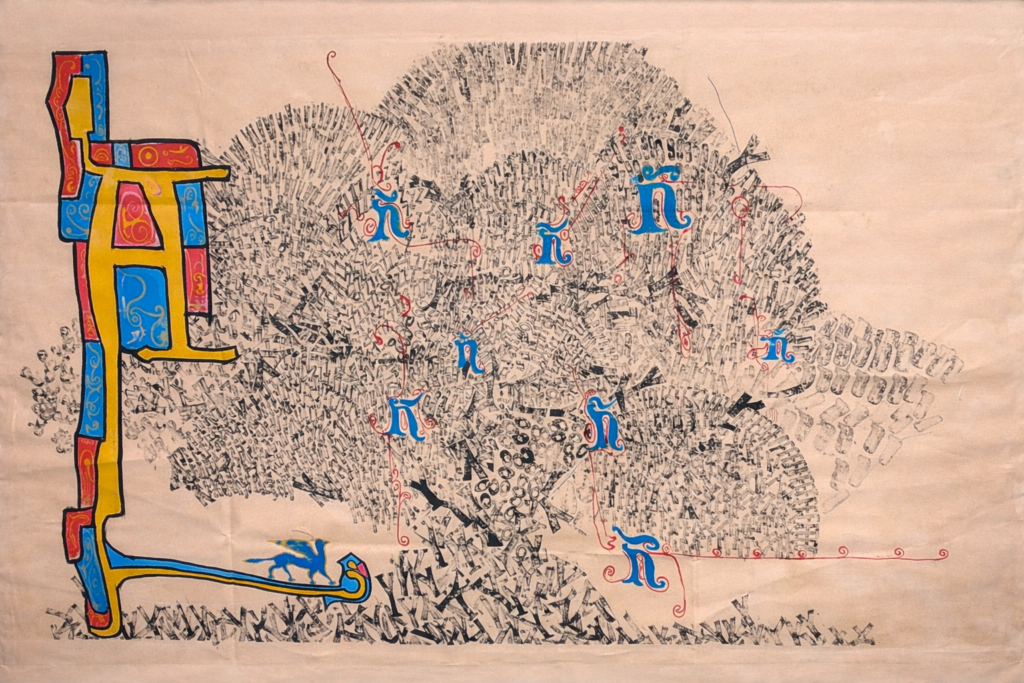
Acrylic on Canvas and imprinted inked wooden letters onto canvas, 3 m × 5 m ≈ 9.8 ft × 16.4 ft
While developing, thinking about, and painting this series, I understood that I needed to return to the concept that gave rise to the entire project: The Tree of Longings. This work predates the series dedicated to the Universal Declaration of Human Rights and functions as its conceptual root.
This is not my first calligraffiti piece, but rather my first direct foray into typography as image, within the expanded field of calligraffiti understood as a fusion of calligraphy, typography, and graffiti. To create it, I acquired large-format antique wooden letters. I inked each letter and, using a rubber mallet, struck the canvas to leave its imprint. The result is a tree made of words, because both the Constitution and the Declaration are, essentially, constructed of language.
Several letters “ñ” appear in the work, a letter unique to Spanish, serving as a direct indication that the Colombian Constitution is written in this language. The large letter A, inspired by illuminated initials in medieval manuscripts, stands for árbol (tree) and draws on the medieval French Canzoniere (Songbook), a manuscript filled with songs and poems. This choice underscores the optimistic and hopeful dimension of human rights. A small decorative dragon accompanies the letter, following the tradition of medieval illumination.
Read Chansonnier du roi (El cancionero) pdf -E-book
05 - PROJECT PUBLICATIONS
+ Click to open each document +
This section brings together the editorial publications that accompany the development of the project. Each booklet functions as an extension of the work, conceived to circulate, be read, and shared, and to conceptually document each new stage of the codex.
The publications are conceived as a growing series that will expand as new sections of the project are developed
Publication 01 — El Árbol de los Anhelos (2025) 🟢 * CO
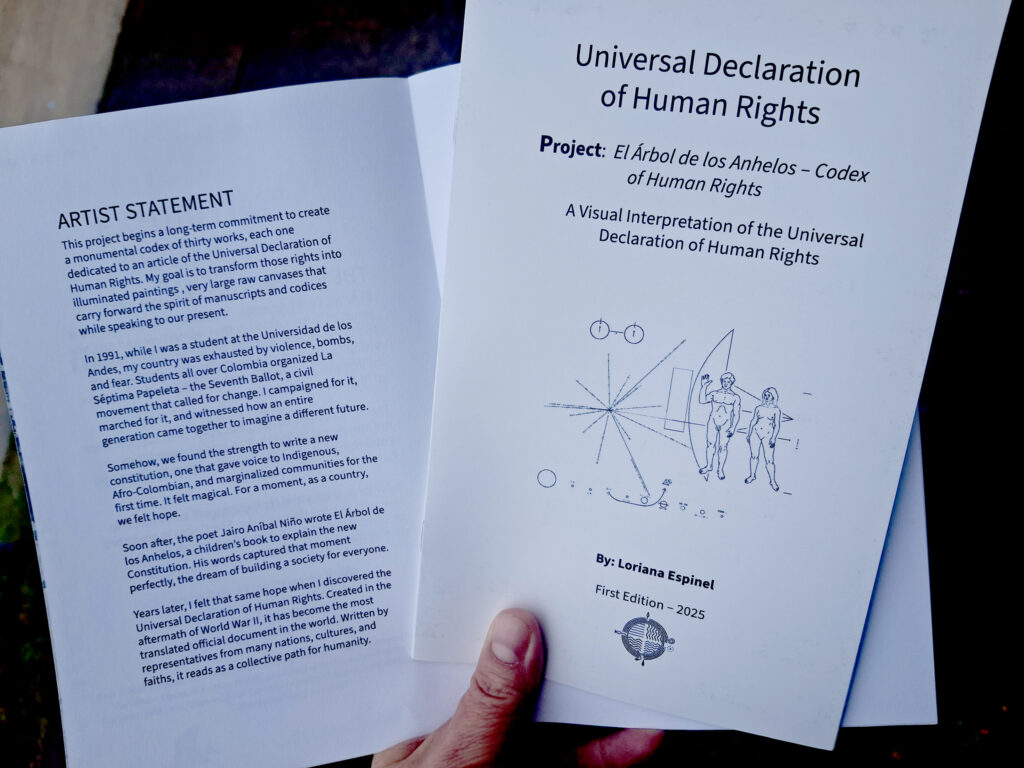
An editorial booklet accompanying the first stage of the project, The Tree of Longings, was developed in Houston, Texas.
The publication contains the exhibition invitation, a general explanation of the project, and the text of the Universal Declaration of Human Rights. The content is presented in English, in keeping with the context in which the work was developed.
Fifty printed copies were produced and distributed free of charge during the project’s public presentation.
06 - AUDIOVISUAL DOCUMENTATION
This section brings together audiovisual records of the working process, live painting, and the public presentation of the project
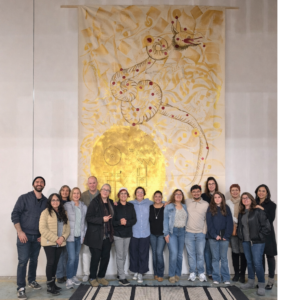
Ver archivo View the complete photo archive of the event (Google Drive) 🟢 * CO
07 – CREATION TIMELINE
2025 🟢 * CO Development of The Tree of Wishes, a work that establishes the conceptual foundation of the codex. In December, I received support from the Ministry of Culture, Arts, and Knowledge of Colombia, enabling the production, exhibition, and public presentation of the project. This process culminated in the completion of five works, corresponding to the first articles of the series dedicated to the Universal Declaration of Human Rights.
2024 Beginning of the research process and the development of calligraphy as a visual language, leading to a specific focus on calligraffiti as an interdisciplinary practice. During this period, I presented the solo exhibition Chiribiquete, in which the first conceptual and formal explorations that would give rise to the project were consolidated.