
Voy a escribir una carta
1- The project
ARTIST STATEMENT
An Artistic Practice of Reading, Writing, and Democratic Participation
I Am Going to Write a Letter is an artistic practice that accompanies The Tree of Longings: A Codex of Human Rights. Through this practice, I write handwritten letters addressed to Colombian members of Congress, based on my study of bills currently before the Congress of the Republic.
While my paintings investigate the Universal Declaration of Human Rights as a proposal for how we should treat one another, these letters bring that investigation into the exercise of democratic participation.
The project emerged during the development of The Tree of Longings, when I began to ask how an artistic practice could participate in public life while remaining within the language and questions that run through my work.
The project takes place in Colombia because it is the country of which I am a citizen and where my political memory and understanding of rights were formed. While studying the mechanisms for participation established by the 1991 Political Constitution, I discovered the right of citizens to address their representatives. This discovery gave rise to the project and transformed a constitutional procedure into the procedure of the artwork itself.
Each letter begins with the selection of a bill. From there, I study the legislative text, investigate its context, develop my own position, and write to the members of Congress responsible for debating or voting on it. The work uses the same procedure that the Constitution makes available to every citizen.
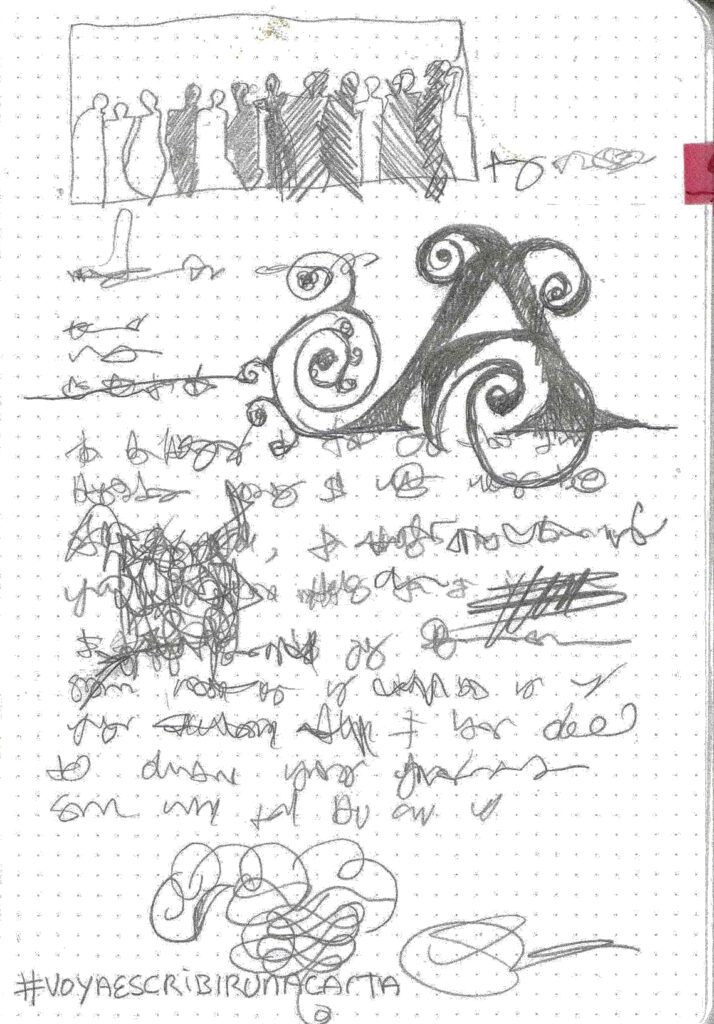
The letter arises naturally from my artistic practice. For years, I have investigated writing as image, object, and event through calligraffiti, understood as a system in which calligraphy, typography, and graffiti converge. In this project, writing functions simultaneously as text, image, correspondence, and action.
Each letter is written entirely by hand. The original manuscript remains in the project archive; a signed facsimile is sent by physical mail to the Congress of the Republic, and a digital version in PDF format is sent to the corresponding members of Congress.
Each letter is accompanied by a video that introduces the selected bill, explains why it was chosen, identifies the members of Congress responsible for its legislative process, and shares the position developed in the letter. The videos document the complete procedure and expand the public space of the work.
Each letter exists simultaneously as a contemporary manuscript, a work of art, a citizen document, physical correspondence, a digital archive, and a piece of The Tree of Longings: A Codex of Human Rights.
The work resides not only in the letters themselves, but also in the procedure through which an artistic practice enters an existing democratic mechanism. Research, reading, writing, correspondence, and public circulation collectively constitute the work.
Methodology
Each letter begins with a bill that is still under consideration by the Congress of the Republic of Colombia. The process includes legislative research, the development of a position, handwritten production, delivery, and follow-up.
1. Selection of a bill
The search begins in the Legislative Search Portal of the Congress of the Republic.
Bills are selected according to their relationship to human rights, collective life, or the social and environmental conditions that make the exercise of those rights possible.
The bill must still be under consideration, at a stage when civic participation can contribute to the discussion.
2. Development of the legislative file
The information necessary to understand the bill and its progress through Congress is gathered:
- bill number and title;
- full text of the bill;
- statement of purpose;
- committee reports and amendments;
- Congressional Gazettes;
- current stage of the legislative process;
- responsible committee;
- sponsors, rapporteurs, and coordinating rapporteurs;
- relevant legislative history.
Before proceeding, the information is verified to ensure that it reflects the bill’s most recent status.
3. Reading and analysis
The proposal, its principal articles, and the changes it could produce in society are examined.
The question is not only what the bill says, but also:
- what problem it attempts to address;
- who may benefit or be affected;
- what rights it protects, limits, or transforms;
- what consequences its provisions may have.
4. Development of a position
Based on this research, each letter develops an argued position. It may:
- support the bill;
- propose amendments;
- question specific articles;
- request that the bill continue through the legislative process;
- or ask for it to be withdrawn or archived.
The arguments are supported by the legislative file and, when necessary, by additional research, evidence, and sources.
5. Identification of recipients
The letter is addressed to those who have the institutional responsibility to study, amend, or vote on the bill at its current stage.
If the bill is under consideration in a committee, the recipients may include:
- rapporteurs and coordinating rapporteurs;
- members of the corresponding committee;
- the committee secretariat.
If the bill has reached a plenary session, the letter is addressed to the members of the legislative chamber participating in the debate and vote.
Names, positions, and contact information are verified through the official websites of the Chamber of Representatives and the Senate.
6. Drafting, verification, and handwriting
The content of the letter is first drafted and reviewed. Its arguments, sources, bill number, legislative status, and recipients are verified.
After this review, the final version is written entirely by hand. The handwritten original constitutes the unique artwork.
7. Reproduction and delivery
Each letter produces:
- the handwritten original;
- a high-quality photocopy for the project archive;
- a scanned PDF file.
The original is sent to Congress by postal mail. The PDF is emailed to the appropriate recipients. Postal receipts and records of electronic delivery are retained.
8. Archive and follow-up
Each letter is preserved with a file containing:
- a copy of the handwritten work;
- the sources consulted;
- the bill’s legislative information;
- the recipients;
- the date and methods of delivery;
- proof of delivery;
- any responses received;
- subsequent amendments;
- votes and the final legislative outcome.
The process does not end when the letter is sent. Each bill is followed to determine whether it is amended, approved, withdrawn, or archived.
02 - PROJECT STATUS AND LEGEND
🟢 Completed
🟡 In progress
03-LETTERS AND BILLS
Each entry brings together a bill, the handwritten letter it generated, and the record of its legislative journey.
The Meta River as a Subject of Rights 🟡
Project Status
Bill
Bill 177 of 2025 (accumulated with Bill 259 of 2025)
The two bills address the recognition of the Meta River, its basin, and tributaries as a subject of rights. During the legislative process, they were accumulated into a single initiative, and the text currently before Congress incorporates elements from both proposals.
Legislative Stage
The accumulated bill has been approved by the Fifth Constitutional Standing Committee of the Chamber of Representatives and is currently awaiting its second debate before the Plenary of the Chamber of Representatives.
This letter is being developed before the plenary debate, while the bill remains under legislative consideration and public participation may still contribute to the discussion.
Project Stage
Stage 4 of 8 — Development of a Position
The legislative file has been completed and verified, including the original bills, committee reports, Congressional Gazettes, legislative history, sponsors, rapporteurs, and the bill’s current legislative status.
Research and analysis have been completed, and the project is now developing the position that will guide the handwritten letter. Once finalized, the recipients will be confirmed, the letter will be written entirely by hand, reproduced for the archive, and delivered before the plenary debate.
Description
This letter forms part of The Tree of Longings, an ongoing artistic project that transforms civic participation into handwritten works of art.
Each letter begins with a bill that is still under consideration by the Congress of the Republic of Colombia. Through legislative research, analysis, handwriting, and public participation, each work accompanies a living legislative process rather than commenting on it retrospectively.
This first letter follows Bill 177 of 2025, accumulated with Bill 259 of 2025, which seeks to recognize the Meta River, its basin, and tributaries as a subject of rights, establishing legal mechanisms for their protection, conservation, maintenance, restoration, and representation.
Rather than advocating from outside the legislative process, the project enters it. Each handwritten letter is addressed to the legislators responsible for debating the bill at its current stage, becoming simultaneously a civic intervention, an archival document, and a unique work of art.
The project continues to follow each bill after the letter has been sent, documenting amendments, debates, votes, and the final legislative outcome. In this way, each work records not only the making of the artwork, but also the life of the law itself.